
 All news
REDD for GUS: The Role of Non-Public Databases in the Development of Real Estate Statistics
About GUS:
The role of official statistics is to systematically provide the public, state bodies, public administration, and entities of the national economy with reliable and objective information about the economic, demographic, and social environment. In the area of economic statistics, an important subject of analysis is the phenomena occurring in the commercial real estate market.
Challenge:
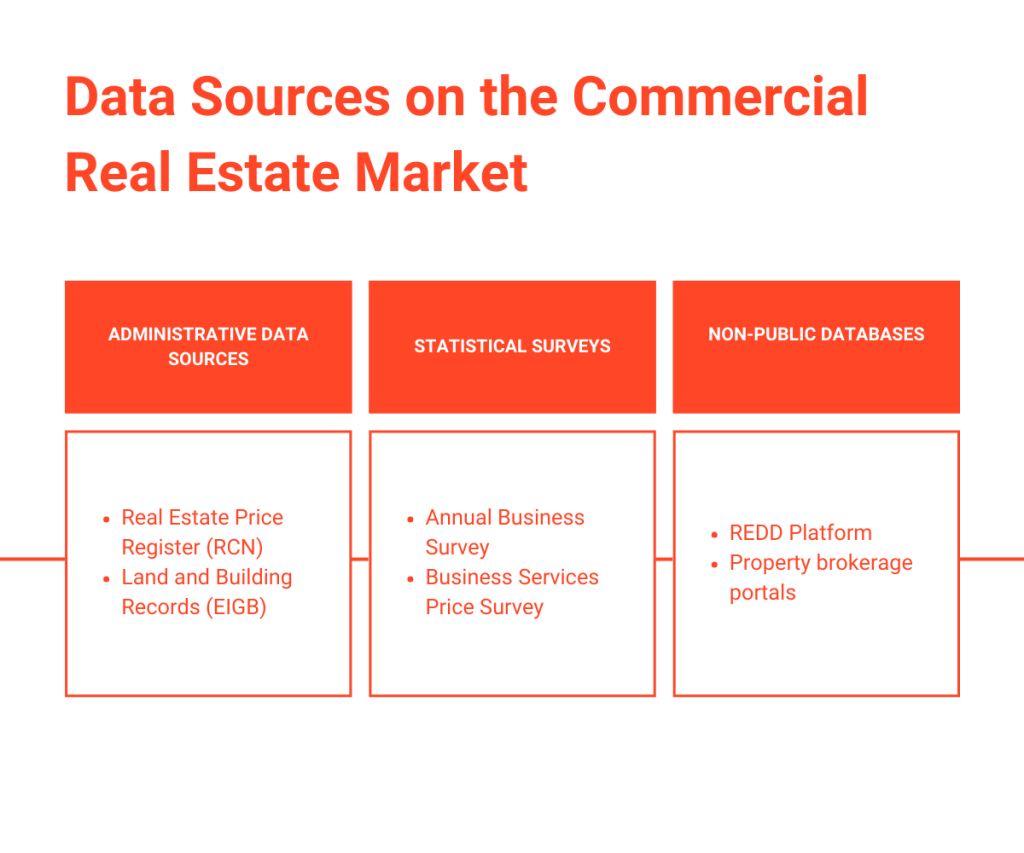
Studying the commercial real estate market is a significant challenge for Polish official statistics. There is increasing demand for data in this area from national users, and Poland faces several reporting obligations imposed by the European Commission as an EU member state. However, the data collected in public administration information systems are insufficient to monitor the commercial real estate market in Poland. While statistical data on real estate transactions (sourced from Real Estate Price Registers maintained by county offices and cities with county rights) are available, there is a lack of information on the rental market for these properties. This information gap is addressed by data collected in the information systems of private entities, including those collected through the REDD Group platform.
Solution:
Given the incomplete information available from administrative sources, GUS has started searching for alternative data sources on the commercial real estate market. After identifying the relevant data holders, steps were taken to establish cooperation with them and gain access to their databases. Unfortunately, the outbreak of the coronavirus pandemic disrupted these plans.
“The light at the end of the tunnel turned out to be the REDD Group Company, which accepted the invitation to collaborate with public statistics. In 2020, we organized a series of working meetings to understand the construction of the REDD platform, the structures of the underlying databases, and the scope of the collected information. We also participated in webinars dedicated to showcasing the functionality of the REDD platform. An important milestone was the establishment of cooperation principles, culminating in an agreement with the REDD GROUP on 11 February 2021,” recalls Agnieszka Matulska-Bachura, who coordinated the project from the GUS side. She adds, “It should be noted that REDD has become a pioneer among the managers of non-public data sources by providing data sets to public statistics free of charge. Public statistics, in turn, gained access to a database of information on the commercial real estate rental market located in selected Polish cities.”
The next stage of the work involved analyzing the data obtained from REDD and attempting to develop office property rental price indices based on it. The REDD databases consist of relationally linked tables containing various ranges of information.
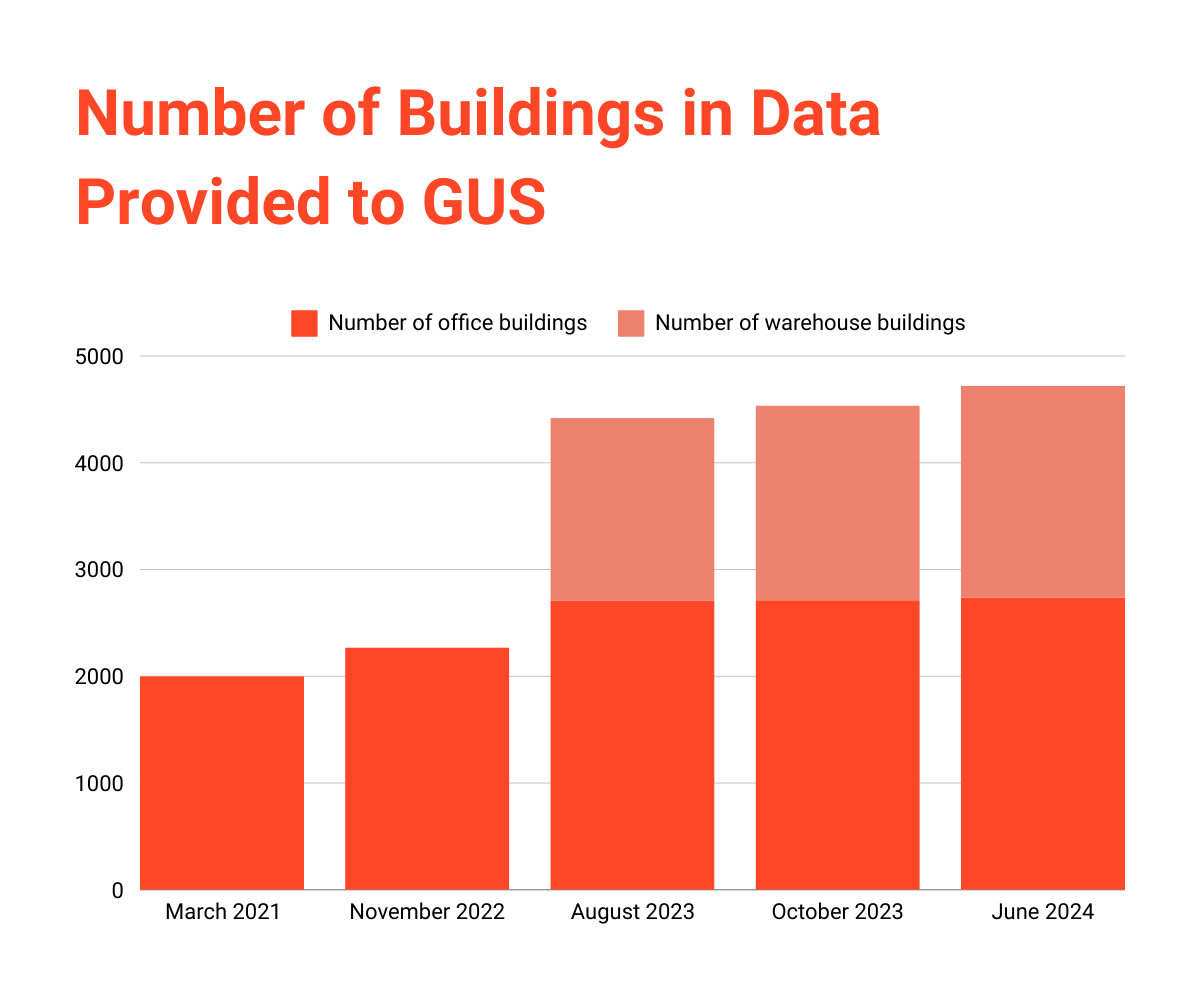
As a first step, an analysis was conducted on the completeness of the acquired datasets, focusing on the number of office buildings with quotations and the extent to which fields containing essential information for index preparation (e.g., building area) were filled. Due to the continuous development of the databases and modifications made to the REDD platform, it was necessary to analyze the table structures and the range of fields provided for individual variables with each data transmission.
The work carried out by GUS using REDD data for 2020-2023 focused on the office property market. Currently, the REDD databases also include warehouse properties. However, due to the small number of listings and insufficient time series for these commercial properties, this category was not included in the statistical work. The primary data used were collected in a table containing database snapshots with basic information about a given building, such as total building area and area available for rent, rent price and currency, service charges, availability of parking spaces, parking fees, and the number of modules in a given building. To obtain more detailed information on the buildings available for lease, a table dedicated to building descriptions was used, which included information on the name, address, and geolocation of the building, certificates awarded (BREEAM, DGBN, HQE, LEED, WELL), class of office building (A, B, C), year of completion, distance from the city center, proximity to parks, parking spaces, building area (total, gross, net, available), and its status (existing, under construction, planned).
Agnieszka Matulska-Bachura points out: “During our cooperation, we have observed a dynamic development of REDD databases. Both the subject scope of the databases (i.e., the number of registered properties, the frequency of listings) and the scope of information characterizing the properties increased. On January 1, 2020, information for 13 voivodship cities (1,453 office buildings) was available in the database, while on October 14, 2023, the scope of observation already included all voivodship cities and 2,325 office buildings.” However, this does not mean that rental price indices could be compiled for all voivodship cities, primarily due to the insufficient number of office buildings included in the REDD databases throughout the analysis period.
As with other non-public sources of commercial real estate data, Warsaw dominates the REDD databases among voivodship cities. In Q1 2020, office buildings located in Warsaw accounted for 48.2 percent of the total number of office buildings and 51.3 percent of the total leasable area in the 12 cities selected for the rental price index. This was followed by Kraków with shares of 12.5 percent and 13.8 percent, respectively, and Wrocław with 9.1 percent and 10.2 percent.
Finally, as a result of the work conducted based on REDD data, experimental office building rental price indices were prepared for 12 voivodship cities for the period from Q1 2020 to Q3 2023. A total rental price index was then developed as a weighted average of the indices for these cities. Information on the leased area of office buildings was used as weights. The results prepared based on REDD data were one element of the experimental data set submitted to Eurostat.
Krzysztof Foks, Head of Research at REDD, concludes: “Since 2021 we have been providing regular data on the office market in Poland. Among the information provided are aggregated data on individual office markets, buildings, units, recorded transactions, and owners along with a portfolio summary and our proprietary REDD Index. In 2023, data on the warehouse market was added to the office market data. Among the data provided is information on warehouse parks, buildings, units, and owners. At the final stage of cooperation, we provided the GUS with a total of 13 tables with 2.25 million records containing several tens of millions of data points. Such a vast amount of structured information enables an in-depth analysis of the market and the monitoring of market developments.”
Effects:
The primary outcome of the development work undertaken by GUS was to test the feasibility of using data from non-public sources to develop indicators for the commercial property lease market. The analyses performed and the experience gained validate the actions taken by public statistics to utilize data from non-statistical sources in real estate market statistics. These conclusions are particularly significant in light of the legal regulations introduced at the European Union level (the so-called Data Act*), which enhance the powers of public statistics to use data from non-public sources.
“Information collected by private operators, including REDD, fills an information gap in the area of commercial property rental data. However, our experience shows that each of the data sources available to public statistics covers only selected categories of real estate within its scope. Therefore, to conduct comprehensive analyses of the entire commercial real estate market, it is necessary to combine data from various sources,” comments the GUS representative.
“The advantage of data from REDD databases, or from other private sources,” she adds, “is not only that they provide an opportunity to develop methodologies for creating commercial property lease price indices using the basic weighted average method. These sources, thanks to the detailed data characterizing the properties, also allow for the use of more advanced data compilation methods than those currently employed, such as econometric methods. Additionally, they can be a potential source of data for developing so-called rapid estimates of indicators in the commercial real estate market.”
*Regulation (EU) 2023/2854 of the European Parliament and of the Council of 13 December 2023 on harmonised rules on fair access to and use of data and amending Regulation (EU) 2017/2394 and Directive (EU) 2020/1828 (Data Act).
Are you wondering if REDD data can also support your business? Try REDD Basic and see what the platform has to offer—simply create a free account. Need more information or a tailored offer? Contact us!
Let’s Talk About How REDD Can Enhance Your Work
- Gain access to a wealth of detailed data on properties
- Accelerate data collection and listing creation
- Track tenant interest in properties
- Monitor market transactions
Who trusted us


Book a meeting
Let us help you learn about REDD
All Done!
We will contact you as soon as possible and answer all Your questions.
Can't wait? Call me:

Please provide your business e-mail address.
All-in-one platform for CRE professionals
Single source for lease rates, available spaces and transaction history. Analytics and reporting capabilities. Landlord contact information. Complete oversight and real-time data updates.
Explore the platform

