
 All news
Dominik Łoś: The aspect that garners the most interest and questions from tenants is the energy efficiency of buildings
How did the warehouse market perform in the first half of 2024? The latest REDD Warehouse Report confirms that trends initiated in the previous year continued. However, some processes exhibited a completely different dynamic. There is also a strong openness to change on the horizon, particularly those aimed at environmental protection. How do industry experts assess the first six months of this year?
Dominik Łoś, Head od Leasing, LCube:
In the first half of 2024, the Polish warehouse market experienced further stabilization of rental rates and a year-on-year decline in demand. The decrease in the volume of leased space compared to the previous year was primarily driven by the economic slowdown in Western European countries and modest GDP growth in Poland, which, according to the Central Statistical Office (GUS), increased by 2.0% year-on-year in real terms in Q1 2024. The stabilization of rental rates was largely due to the substantial new supply introduced to the market in 2023, leading to high availability of space in most regional markets, as well as stabilized construction and investment financing costs in the warehouse property sector. Despite a continued decline in manufacturing output, there is cautious optimism regarding the growth of retail sales (consumption), spurred by falling inflation and rising real incomes. The National Bank of Poland (NBP) forecasts ongoing consumption growth in 2024 and anticipates GDP growth to accelerate to 3.6% in 2025.
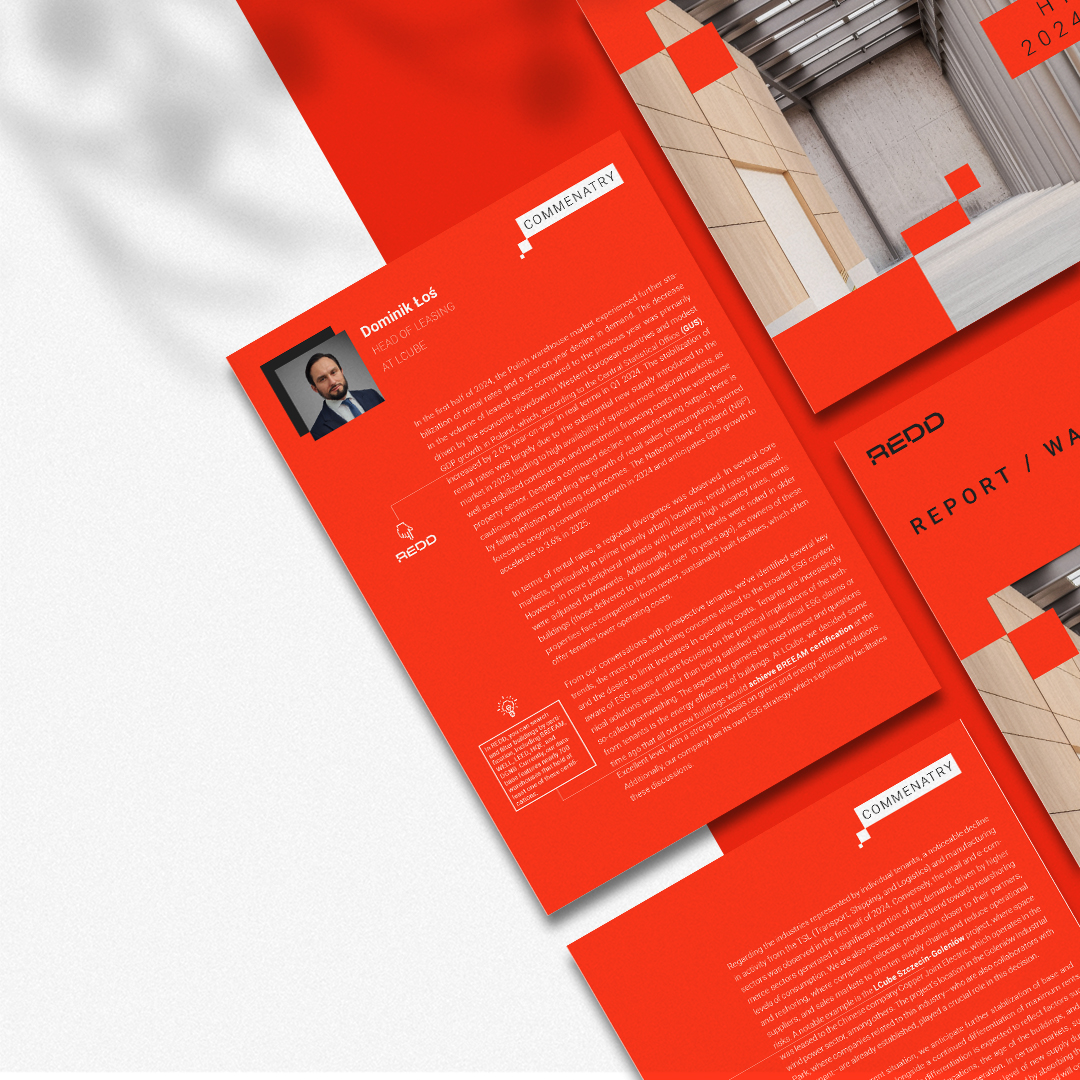
In terms of rental rates, a regional divergence was observed. In several core markets, particularly in prime (mainly urban) locations, rental rates increased. However, in more peripheral markets with relatively high vacancy rates, rents were adjusted downwards. Additionally, lower rent levels were noted in older buildings (those delivered to the market over 10 years ago), as owners of these properties face competition from newer, sustainably built facilities, which often offer tenants lower operating costs. From our conversations with prospective tenants, we’ve identified several key trends, the most prominent being concerns related to the broader ESG context and the desire to limit increases in operating costs. Tenants are increasingly aware of ESG issues and are focusing on the practical implications of the technical solutions used, rather than being satisfied with superficial ESG claims or so-called greenwashing. The aspect that garners the most interest and questions from tenants is the energy efficiency of buildings. At LCube, we decided some time ago that all our new buildings would achieve BREEAM certification at the Excellent level, with a strong emphasis on green and energy-efficient solutions. Additionally, our company has its own ESG strategy, which significantly facilitates these discussions.
Regarding the industries represented by individual tenants, a noticeable decline in activity from the TSL (Transport, Shipping, and Logistics) and manufacturing sectors was observed in the first half of 2024. Conversely, the retail and e-commerce sectors generated a significant portion of the demand, driven by higher levels of consumption. We are also seeing a continued trend towards nearshoring and reshoring, where companies relocate production closer to their partners, suppliers, and sales markets to shorten supply chains and reduce operational risks. A notable example is the LCube Szczecin-Goleniów project, where space was leased to the Chinese company Copper Joint Electric, which operates in the wind power sector, among others. The project’s location in the Goleniów Industrial Park, where companies related to this industry—who are also collaborators with our tenant—are already established, played a crucial role in this decision.
Analyzing the current situation, we anticipate further stabilization of base and effective rental rates, alongside a continued differentiation of maximum rents across regional markets. This differentiation is expected to reflect factors such as the attractiveness of specific locations, the age of the buildings, and the proximity to the center of a given agglomeration. In certain markets, such as Wroclaw and Łódź, we foresee a relatively low level of new supply due to the high vacancy rates (over 10%) that need to be reduced by absorbing the existing stock of warehouse space. Only after this surplus is absorbed will conditions be favorable for the initiation of new warehouse projects.
We are also anticipating an increase in activity from logistics operators, which was relatively low in the first half of the year, as well as continued demand from retail and e-commerce tenants. The most significant challenge for tenants will likely be the further rise in property operating costs, driven by expected increases in inflation during the second half of the year, along with higher minimum wages and electricity costs. This is likely to intensify pressure on property owners, who will face growing expectations from tenants to implement more energy-efficient solutions, both in new and existing buildings, including adaptations to enable the use of renewable energy sources (such as direct supply from photovoltaic farms or energy storage systems). Additionally, due to demographic changes and labor market dynamics, we foresee continued advancements in automation and robotization among tenants in the manufacturing and e-commerce sectors. In REDD, you can search and filter buildings by certification, including BREEAM, WELL, LEED, HQE, and DGNB. Currently, our database features nearly 700 warehouses that hold at least one of these certifications.
Let’s Talk About How REDD Can Enhance Your Work
- Gain access to a wealth of detailed data on properties
- Accelerate data collection and listing creation
- Track tenant interest in properties
- Monitor market transactions
Who trusted us


Book a meeting
Let us help you learn about REDD
All Done!
We will contact you as soon as possible and answer all Your questions.
Can't wait? Call me:

Please provide your business e-mail address.
All-in-one platform for CRE professionals
Single source for lease rates, available spaces and transaction history. Analytics and reporting capabilities. Landlord contact information. Complete oversight and real-time data updates.
Explore the platform

